Flash, then bang
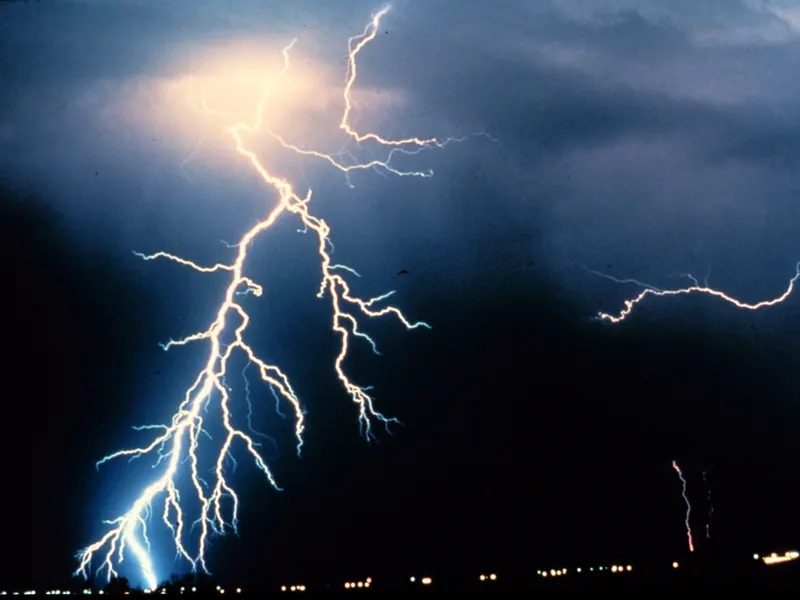
The lightning and the thunder happen together. Light reaches you almost instantly; the sound takes its time. Count the gap and you can work out how far away the strike was.
What thunder is
Thunder is the acoustic shock wave caused by the extreme heat of a lightning flash. NOAA JetStream: The sound of thunder The air in the lightning channel heats so fast that it expands explosively, and that makes the sound. NOAA JetStream: The sound of thunder
Lightning heats the air in its channel to above 50,000 °F in only a few millionths of a second. NOAA NSSL: Lightning FAQ
Thunder is a shock wave for the first 10 yards, then it becomes an ordinary sound wave. NOAA NSSL: Lightning FAQ
Why you see it first
The lightning and the thunder clap happen at the same time. You see the flash first because light is far faster than sound. Met Office: Thunder and lightning
The Met Office gives the speed of light as 299,792,458 m/s and the speed of sound as 340.29 m/s. Met Office: Thunder and lightning
In air at 20 °C, sound travels at about 343 metres per second. At 0 °C it’s about 331 m/s. NOAA Global Monitoring Laboratory: Using sound waves (speed of sound table) Sound waves move faster in warm air than in cool air. NOAA JetStream: The sound of thunder
A NOAA table of the speed of sound in air: 325 m/s at −10 °C, 331 at 0 °C, 337 at 10 °C, 343 at 20 °C and 349 at 30 °C. NOAA Global Monitoring Laboratory: Using sound waves (speed of sound table)
The flash-to-bang count
Count the seconds from the flash to the thunder. Divide by five for the distance in miles, or by three for kilometres. Met Office: Thunder and lightning
The sound of thunder takes about 5 seconds to travel a mile. National Weather Service: Understanding thunder If you count 15 seconds before you hear the thunder, the lightning is 3 miles (5 km) away. NOAA JetStream: Lightning safety
| Gap | Kilometres (÷ 3) | Miles (÷ 5) |
|---|---|---|
| 3 s | 1.0 km | 0.6 miles |
| 6 s | 2.0 km | 1.2 miles |
| 9 s | 3.0 km | 1.8 miles |
| 15 s | 5.0 km | 3.0 miles |
| 30 s | 10.0 km | 6.0 miles |
The rule is a shortcut: our table just divides by 3 and by 5. 5 seconds = 1 mile, 15 seconds = 3 miles, 0 seconds = very close. National Weather Service: Understanding thunder
Keep in mind that you should be in a safe place while counting. National Weather Service: Understanding thunder When you hear thunder, you are already within range of where the next ground flash may occur. Met Office: Stay safe in thunder and lightning
Practise: how far was that strike? →
What it sounds like
A sharp crack or click means the lightning channel passed nearby. A rumble means it was at least several miles away. National Weather Service: Understanding thunder Generally, the louder the thunder, the closer the lightning. Met Office: Thunder and lightning
Thunder lasts longer than lightning because the sound comes from different parts of the long lightning channel. Met Office: Thunder and lightning
How far can you hear it?
Thunder can be heard for a distance of only about 10 miles. National Weather Service: Understanding thunder Thunder normally has an audible range of up to 10 miles (16 km). NOAA JetStream: The sound of thunder
The Met Office says thunder is rarely heard more than 20 km away. Met Office: Thunder and lightning
You might see lightning and not hear the thunder because the storm is too far away. This is sometimes called “heat lightning”, because it happens most often in summer. NOAA NSSL: Lightning FAQ
The snow in a thundersnow storm dampens the sound, so you’ll only hear the thunder within 2 to 3 miles of the lightning. Met Office: Thunder and lightning
Next: staying safe →