How lightning works
Ice and soft hail bash together inside a storm cloud, charges build up, and then the air gives way in a giant spark.
A giant spark
Lightning is a giant spark of electricity in the atmosphere, or between the atmosphere and the ground. National Weather Service: Lightning science overview Lightning is a huge electrical discharge that flows between clouds, from a cloud to the air, or from a cloud to the ground. Met Office: Thunder and lightning
Lightning is one of the oldest observed natural phenomena on Earth. NOAA NSSL: Lightning basics Scientists still haven’t verified exactly how lightning forms. NOAA JetStream: How lightning is created
Where storms come from
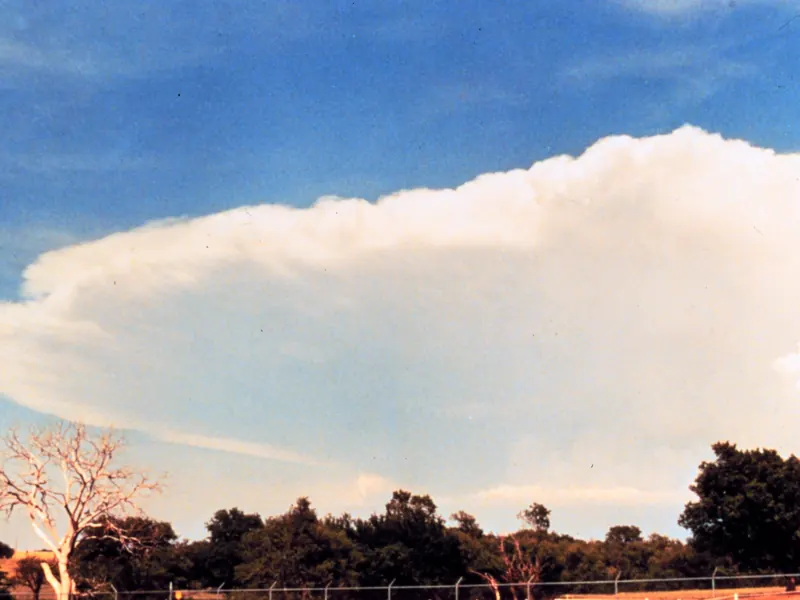
Thunderstorms develop when the atmosphere is unstable: when warm air sits underneath much colder air. Met Office: Thunder and lightning
Thunderstorm updrafts can carry air to between 35,000 and 70,000 feet (about 10.7 to 21.3 km). NOAA JetStream: How lightning is created
Charging up the cloud
Inside a storm, collisions make a soft hail called graupel. When graupel bumps into water droplets and ice, electrons are sheared off the rising particles and collect on the falling ones. NOAA JetStream: How lightning is created
As hail falls through the cloud it gains a negative charge, while the ice particles carried upwards gain a positive charge. So the top of the cloud becomes positive and the lower part negative. Met Office: Thunder and lightning
The strike, step by step
- A stepped leader comes down from the cloud in steps, each one quicker than a blink. It’s invisible to the human eye. NOAA JetStream: How lightning is created
- Electrons shoot down from the cloud, cutting through the air at around 270,000 miles per hour. Met Office: Thunder and lightning
- Streamers: these reach up from the ground as the lightning leader comes down. People caught in streamers are at risk of being killed or injured. National Weather Service: How people are struck by lightning
- The bright flash you see is the return stroke, which carries more than 99% of the light. NOAA JetStream: Lightning FAQ
- One flash is usually several strokes, only hundredths of a second apart. Met Office: Thunder and lightning
How big, how hot, how powerful?
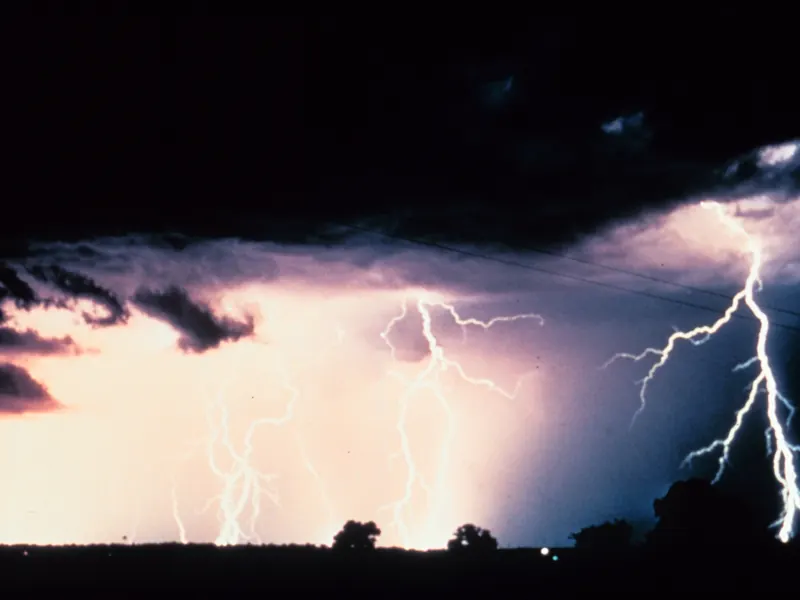
A lightning bolt is only about 2–3 cm wide, but on average about 2–3 miles long. Met Office: Thunder and lightning
Lightning heats the air to up to 30,000 °C almost instantly: five times hotter than the surface of the Sun. Met Office: Thunder and lightning The National Weather Service puts it at 50,000 degrees Fahrenheit, 5 times hotter than the surface of the Sun. National Weather Service: Understanding thunder
An average lightning bolt carries about 30,000 amps and has 300 million volts of electric potential. NOAA JetStream: Lightning FAQ Lightning can have 100 million to 1 billion volts, and contains billions of watts. NOAA NSSL: Lightning FAQ
Where it happens
Most lightning, about 75–80%, happens inside the storm cloud itself. NOAA JetStream: How lightning is created Lightning between charges inside the storm cloud is intra-cloud lightning. Lightning between the cloud and the ground is cloud-to-ground lightning. National Weather Service: Lightning science overview
Lightning often strikes the same place repeatedly, especially a tall, pointy, isolated object. National Weather Service: Lightning myths
Lightning isn’t only in thunderstorms. It can be seen in volcanic eruptions, extremely intense forest fires, heavy snowstorms and large hurricanes. NOAA NSSL: Lightning FAQ When thundersnow happens at night, the lightning looks brighter, because the light reflects off the snowflakes. Met Office: Thunder and lightning
What it leaves behind
When lightning hits sand, it can melt it into a glassy rock called a fulgurite, shaped like a twisty tube. NOAA NSSL: Lightning FAQ
Good to know
Can you have thunder without lightning? No. Thunder is caused by lightning. NOAA NSSL: Lightning FAQ
What’s the difference between a thundershower and a thunderstorm? Technically, there’s none. NOAA JetStream: Lightning FAQ
Next: thunder & distance →